Concrete Beam Design, unlike most competing programs, was written to design reinforced concrete beams completely and accurately. So while competing programs simply give an area of steel or maybe a single stirrup spacing, Concrete Beam Design checks all the ACI provisions for strength serviceability and constructability.
Concrete Beam Design was written with simplicity and compatibility in mind. Inputs are concisely organized using a minimum of dialog boxes. Like other Digital Canal products, reports are created in Rich Text Format (RTF) and automatically displayed in Microsoft Word Viewer or any user selected word processor.
Key program features include:
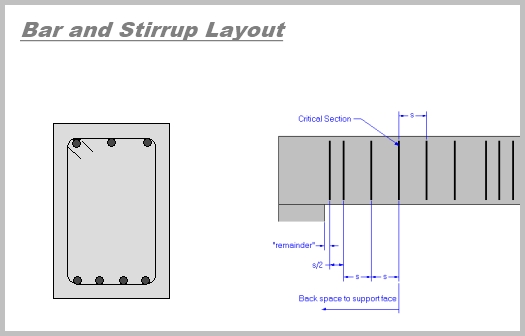
- Stirrup spacing is computed to ensure adequate strength for each section of the beam while keeping the number of stirrups to a minimum, maintaining adequate cover and minimizing spacing changes. Spacing is rounded to the nearest inch for constructability.
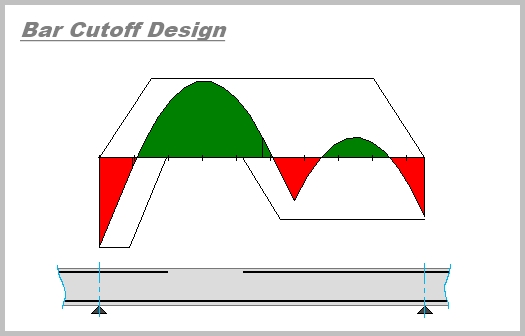
- Secondary considerations such as crack control, minimum reinforcement, development length, deflection (including time effects), tension zone cuts and compression steel are accounted for.
- Loads include end moments, concentrated, uniform, linear and triangular load distributions. The standard load combination list includes the ACI combinations and is customizable.
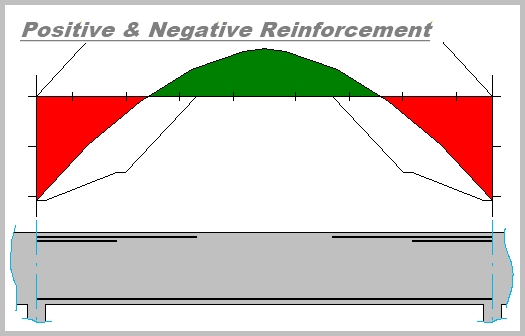
- Graphic output include shear and moment capacity diagrams-invaluable for design verification. Graphic output can be viewed on the screen, printed and saved to a DXF file.
- Concrete Beam Design can be bought separately—you don’t need to buy a “structural system” or “engineering library” to design a concrete beam.
- Reports are in Microsoft Word format (RTF) giving you unequalled compatibility with other software.
- Flexible unit controls allow for US or metric designs.
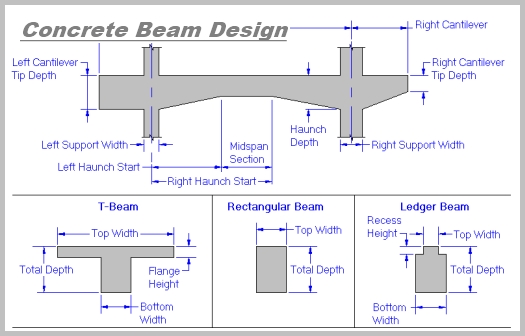
- Graphic “backgrounds” illustrate program inputs.
- Simple file format—only one file per project, which can be opened and saved in typical Windows fashion.
- Stirrup spacing is computed to ensure adequate strength for each section of the beam while keeping the number of stirrups to a minimum, maintaining adequate cover and minimizing spacing changes. Spacing is rounded to the nearest inch for constructability.
- Secondary considerations such as crack control, minimum reinforcement, development length, deflection (including time effects), tension zone cuts and compression steel are accounted for.
- Loads include end moments, concentrated, uniform, linear and triangular load distributions. The standard load combination list includes the ACI combinations and is customizable.
- Graphic output include shear and moment capacity diagrams-invaluable for design verification. Graphic output can be viewed on the screen, printed and saved to a DXF file.
- Concrete Beam Design can be bought separately—you don’t need to buy a “structural system” or “engineering library” to design a concrete beam.
- Reports are in Microsoft Word format (RTF) giving you unequalled compatibility with other software.
- Flexible unit controls allow for US or metric designs.
- Graphic “backgrounds” illustrate program inputs.
- Simple file format—only one file per project, which can be opened and saved in typical Windows fashion.